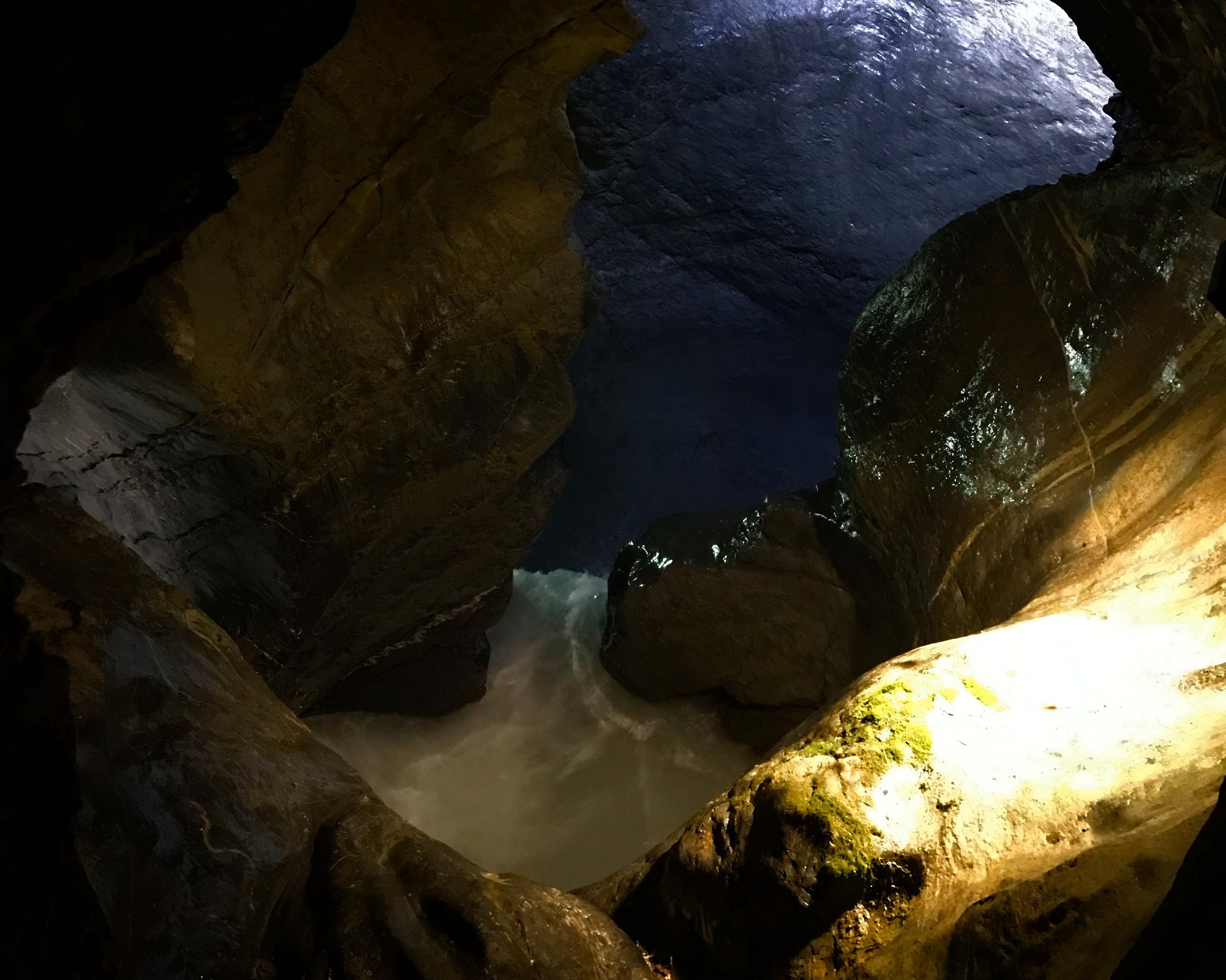
Another fiery hot headache erupts inside your skull turning pale cheeks crimson. Disappearing beneath a thin, black blanket—you retreat into the cave’s deep crisp darkness. I suppress bubbling anger’s hot breath tight inside infinities compassionate heart; draining like cups lining crowded cracked windowsill. Please,
be okay. Worry lines crease, carve my aging mom face— chiseled rock tracing waters long cascading movements through life’s echoey darkness. Foamy pools of cooling relief sit waiting for moments to pass, for pacing eons to eek by into light’s laughing return. Heart remembers every nighttime outcry, each soothing back rub. Please,
be okay. Reaching through foggy depths flash flooded with writhing madnesses ugly nightmares, your fingers wind tight around blankets edge; my feather-soft motherly kisses on soaked brows do nothing. Anger ripples dirty clothes piled high igniting guilt’s powerful ringing rage pounding ancient rocks into fine powdery dust. Please,
be okay. Fear transforms uneven tapering columns into screeching monsters to slay. Drawing wet sword angry words drip, drip, drip through silence too thick for thinking. Screams soften by plunging heavy, headfirst into icy water’s depth to see through stinging eyes past adventures where love’s sweet patience held fast. Please,
be okay. Lashing, tearing with pain’s tired hoarse voice blame begets blame until desperate razor-sharp rockslides throw open windows repose letting sweet swirling wind signal truce. Whispered kindness wipes at particles left stinging, laughing off this dance, forgetting how darkness clung everywhere at once—embracing love’s shining light.
My teenage son suffers from chronic migraines. While I strive to be loving, kind, and motherly at all times, anger bubbles forth when he’s down. It’s anger at the situation, but it becomes anger at everything. We fight when it’s over as if we can keep it from returning by scaring it away. I’m not proud of this pattern and this poem is my attempt at processing my feelings.
Being a parent is like walking blindfolded into the wilderness. You have to use all your senses, listen to your natural instincts, surrender any idea you know what you’re doing, and you can’t call it quits.
Before the pandemic, my kids were involved in all kinds of activities and I felt the rushing movement like a giant truck I was simultaneously riding and driving. We would fight to get out the door and I’d yell. There were too many car meals, bathroom clothing changes, and exhausted tears. I felt overwhelmed and busy, but confident. I did my best, and at the end of the day, I felt good about the efforts I put in.
During the pandemic, all the things my kids claimed to hate but secretly loved, stopped. The life I’d helped them cultivate away from media and technology suddenly revolved around screens. I was here with them all the time, yet I felt like I didn’t really see what was happening. Our lives became a series of solitary moments in our rooms with our phones or computers, interspersed by nature walks and car drives to nowhere. It went on forever, yet it felt like a blip or a bump we’d get past. We expected it would return to normal, but it didn’t.
The pandemic has transformed me as a parent.
This is not what I expected my life to look like at this moment. I suspect some of you, perhaps all of you, can relate in some way.
For me, the fundamental shift is this; my belief my kids will be okay has been replaced with fear and anxiety.
I can trace how it happened.
Early in the pandemic, my son was in a skateboard accident. He got a road rash on his face and arms, knocked out his front teeth, and had a fairly serious concussion. Each first responder and hospital staff member took a moment to yell at him, and by extension me, for him not wearing a helmet. They rubbed it in thoroughly, and I felt their words chipping away the image I had of myself as a mother. I felt bruised and beaten as I nursed my son back to health in a dark room for several weeks, blaming myself for his accident.
A few months later my grandmother died of Covid. I tried to call her once at the hospital, but she was asleep. I didn’t try again. I was scared to talk to her. There’s was so much unsaid between us, and I wanted her to get better so I could say the things. The lost opportunity felt huge while bringing fears of Covid closer to home.
While I tried to convince myself my kids were strong and would fight Covid easily, I was terrified of unknowingly passing Covid onto my mom, who has bad asthma, or to my mother-in-law who is elderly and fighting cancer. Each time I had a tickle in my throat, I’d worry it would develop into something more, and I’d be one of those who weren’t so lucky to fight it off. It wasn’t a rabid fear, but rather a slow-simmering background of fear which chipped away at me bit by bit.
In addition to Covid, I began to fear how people were acting. The division of those who refused masks contrasted with those hoarding supplies and preparing for a sort of social war. All of these things made leaving my house feel risky and dangerous. I stockpiled dried beans, rice, and bottled water. My neighbor and I talked about his guns and how he could protect us; the conversation felt appropriate at the time.
I watched my kids implode in a way I didn’t understand, and still don’t. It wasn’t simply losing school and friends; it was a sort of reckoning of what kind of life they wanted to have. The trajectory of their accomplishments stopped, and they had nothing to be proud of. They had too much time to think about the world, to see all the ugliness of it, and it changed them.
Six months after his first accident, my son had a second one. This time he was hit by a car walking to the store to buy a soda. The police came to the door as I was doing the dinner dishes and I followed in a daze to the hospital. More scraps, another concussion, and a fresh batch of fears for me. The moments of that day play over and over in my head and it’s hard to let him out of my sight. I’m only truly comfortable when he’s home. I worry when he’s at school or with his friends. I obsessively track his phone throughout the day in an attempt to ease the anxiety. If his phone dies or I can’t get in touch with him, I panic.
My daughter, through the isolation from her peers and anxiety of the world, has developed some mental health struggles. I won’t share the specifics to maintain her privacy, but I missed the signs for too long. I felt another blow to my parenting ego, but worse; I felt a terrible sense I’d let her down in all the ways that matter. I had missed the big stuff. I felt selfish and scared.
All of this has changed me as a parent.
I find it hard to return to the way we were before because much of my mental energy has transformed into anxiety and fear.
My kids miss a lot of school and I don’t care about homework. I let them hang with their friends as much as they want, drive them to therapy and support groups. I’ve put thousands of miles on my car listening to their music and hoping they will feel better.
I want them to feel better.
I am also not requiring enough of them so that they can grow in the ways I know they need to. I’m scared to push and to hold them to the standard I did before. They are not falling short; I’ve simply grown fearful of requirements because I don’t want to lose them. I don’t push.
I’m not exaggerating when I tell you I’ve been more worried about my kids dying in the last two years than I did the entire time they were little. I was all about letting them climb a tree, or take a risk. I thought it was good if they got hurt because it showed them a boundary and allowed them to grow.
I’ve lost that.
Now, I fear pushing them will result in dire consequences.
It’s a tightrope of wanting to require more so they feel proud of themselves and grow, but also holding back because I see them as fragile. I know they aren’t as fragile as I’ve made them out to be, but I am.
It feels perilous.
And scary.
How do I become the right kind of hard while still protecting them and myself?
I don’t know.
There’s another component, a sort of social reckoning. What they have experienced has shifted the momentum of their lives. They see their life path, their goals, as something far different than I did at their age. It’s no longer as an individual, but rather how they will be in the world.
They are examining complex things: gender constructs, systematic racism, global warming. There’s a sort of punk rock attitude forming; a kind of new version of the “fuck the man” mentality. Instead of music and drugs, they want marches and social justice reform. They want the world to do better, to be better.
They aren’t going to sleepwalk through their lives, moving from one checked box to the next like I did; high school, college, career, house, kids.
I moved through each thing as if I had no say in the matter; as if all the decisions of my life were preordained and I was simply saying the lines written for me. After all the boxes were checked, I felt cheated and empty. I missed so much because I did what I thought was expected of me. I didn’t slow or pause to examine if the path was what I wanted or if the roles I’d cast myself in fit me anymore.
My kids aren’t doing that.
They think about the kind of lives they want, and although the images are still so unclear, I don’t think they will settle. They don’t believe the story my generation did, and they don’t want the same outcome. I see them looking at me and their father and shaking their heads at how much we don’t question things or fight for a better world. They check us on the language we use and talk about things it’s taken me over 40 years to recognize.
They are facing forward and not shrinking from it. While I see them as fragile, the evidence doesn’t support me. If they can look at the problems in the world with a sort of determined energy of change, how can I see them as weak?
I have hope that all this social awareness is leading to something amazing for their entire generation and, not to be too grandiose, the planet. This outward focus and the ability to accept and empathize with all kinds of people has to be leading to a better world for all of us.
None of this, however, makes it easy to be a mother right now. There are days, more than I care to admit, I wish I could hop into a time machine and do a better job of protecting and shielding my kids. I’d put them in a bubble and not let anything in.
I know that’s not actually true and it’s the fear and the pain talking.
It’s my desire for growth to not hurt, but that’s not how it works.
It hurts.
The story my kids are living, well…it’s their story. All the things they have been through are shaping and molding them. And they are incredible kids.
My challenge has become to support them, to love them, and to go slower. To continue to sit with them in the discomfort, to listen as they question things, and, most importantly, to see my fear as separate from their experience.
The last one has been the hardest for me.
I have to work on healing my own fears around losing them, and not let my decisions be based on either guilt for what they’ve lost or fear I’ll lose them permanently.
I’m trying my best.
Maybe the pushing will come when it feels right, but for now, I observe and I listen. I try and see the ways I can nudge and build on those. These kids have been through so much, and it’s made them strong.
They are freaking rock stars.
My daughter has started having friends over again and they laugh so much. She pours herself into her artwork. It’s for her, not for show or attention. She does art to express her feelings and she holds people accountable for their actions. She sets boundaries, even with me.
My son began working out at the gym and he plays basketball with his friends. He plays guitar in his room for the pure love of it, not caring to impress anyone or show off. He makes everyone laugh, can size up his teachers, and isn’t afraid to call them out when they are being unfair. He forgives me when I hold too tight or freak out, but doesn’t let me off without a fight.
My kids talk to each other all the time. It’s not fake. It’s not superficial. They talk about real stuff and lean on each other.
All of these things are beautiful and real.
My kids aren’t fragile.
I am.
I’m facing forward and I’m doing the best I can, and for that, I need to give myself grace.
No comparing.
No looking back.
I’ve come to realize, parenting doesn’t get easier, and maybe that’s part of the complexity of my own feelings. A bit of sadness my kisses and hugs aren’t magical anymore. A bit of the rose-colored glasses slipping as my kids enter the imperfect world-not the careful world of fairies and magic I crafted when they were little.
While this part of my life feels unsteady and hard, all I can do is keep loving them and trying to do better. As the Everly Brothers sang:
Love hurts, love scars Love wounds and mars Any heart, not tough Nor strong enough To take a lot of pain Take a lot of pain Love is like a cloud Holds a lot of rain
Sometimes my teenage daughter’s anxiety gets too big, and I pick her up early from school.
I know her education is important, but living through a pandemic has changed my priorities and perspective. When she calls me, I don’t hesitate and I don’t make her feel bad. I get her.
Last week I picked her up after a flurry of upsetting texts. She told me her mental health was bad again. It scared me. It scared her. She’d kept it from me for weeks because she didn’t want to make me sad. My heart broke she’d tried to protect me, and I felt I had to say the right thing.
“We face what is,” I said.
These four words felt important.
I repeated them.
“We face what is.”
This opened the door for her to share, and for me to listen. We made plans for her to get new kinds of help, and to pursue roads to healing we hadn’t considered before. I reminded her she isn’t alone, and I’m more interested in her truth than in feeling comfortable and happy.
The next day, I was sitting alone and spiraling out about my eyes.
My eye to be specific.
I’ve got one good eye and one lazy one. It’s been this way my entire life, and normally it’s not on my mind. But lately, I’ve had trouble seeing when I read, or when I’m on the phone. Things were blurry and I couldn’t read the instructions on a medicine bottle. I bought a pair of reading glasses, and it helped. This should have been the end of it.
However, my anxiety over the experience grew and grew. It became unruly, demanding more and more of my attention and emotional energy.
I’d convinced myself I must have some horrible disease, most likely brought on by my weight gain and laziness. I began to tally all the ways I’m failing at caring for myself. I don’t wear my sunglasses all the time. I spend too much time on screens. I don’t blink enough. I got bacon grease in my eye on Christmas morning, which was irresponsible and preventable if I’d paid better attention. I haven’t done enough research to see how to protect my eyesight. I don’t eat enough green leafy vegetables or omega-3 fatty acids. I’m going to lose my ability to see, and it will be my own fault.
As I sat still, berating myself, those four words I told my daughter came to me.
“We face what is.”
I looked up the number of an optometrist near me and made an appointment.
As I sat in the waiting room, all the anxiety and blame thick about me, I kept countering it with those four words. Whatever the eye doctor tells me, I will face. I have family and friends who will love and support me. I can’t face what I don’t know.
As I went through the exam, I made lots of self-deprecating jokes. I knew I had to keep the mood as light as possible, and I had to keep talking.
“Which is better? One or two? Three or four?”
Each question was scary. The letters I couldn’t see felt ominous, surely indicators of something serious. I kept trying to hear it in her voice, waiting for the bad news to drop.
It didn’t.
My eye’s fine. I’m getting older. It’s normal.
Normal.
She prescribed reading glasses, the same kind I’m already using. She told me I’m okay.
We face what is.
I have some other health things I have to face. I’ve put on too much weight. I have pains in my hips and back. I’m concerned I might be pre-diabetic, it runs in my family, or I could be putting too much strain on my heart. I’m taking steps to correct my health, which means facing things like the scale, a check-up at the doctor, and returning to the gym. All of these things feel hard, and damn, there’s a lot of judgment and guilt around them.
However, I can’t do anything without turning toward what is. I have to stop ignoring the truth for some pretend comfort. I have people who count on me, and I have a lot more I want to do with my life. There’s no reason to run from perceived scary things or to let myself build them up until they are monstrous. It’s far better to shine a light on them.
We face what is.
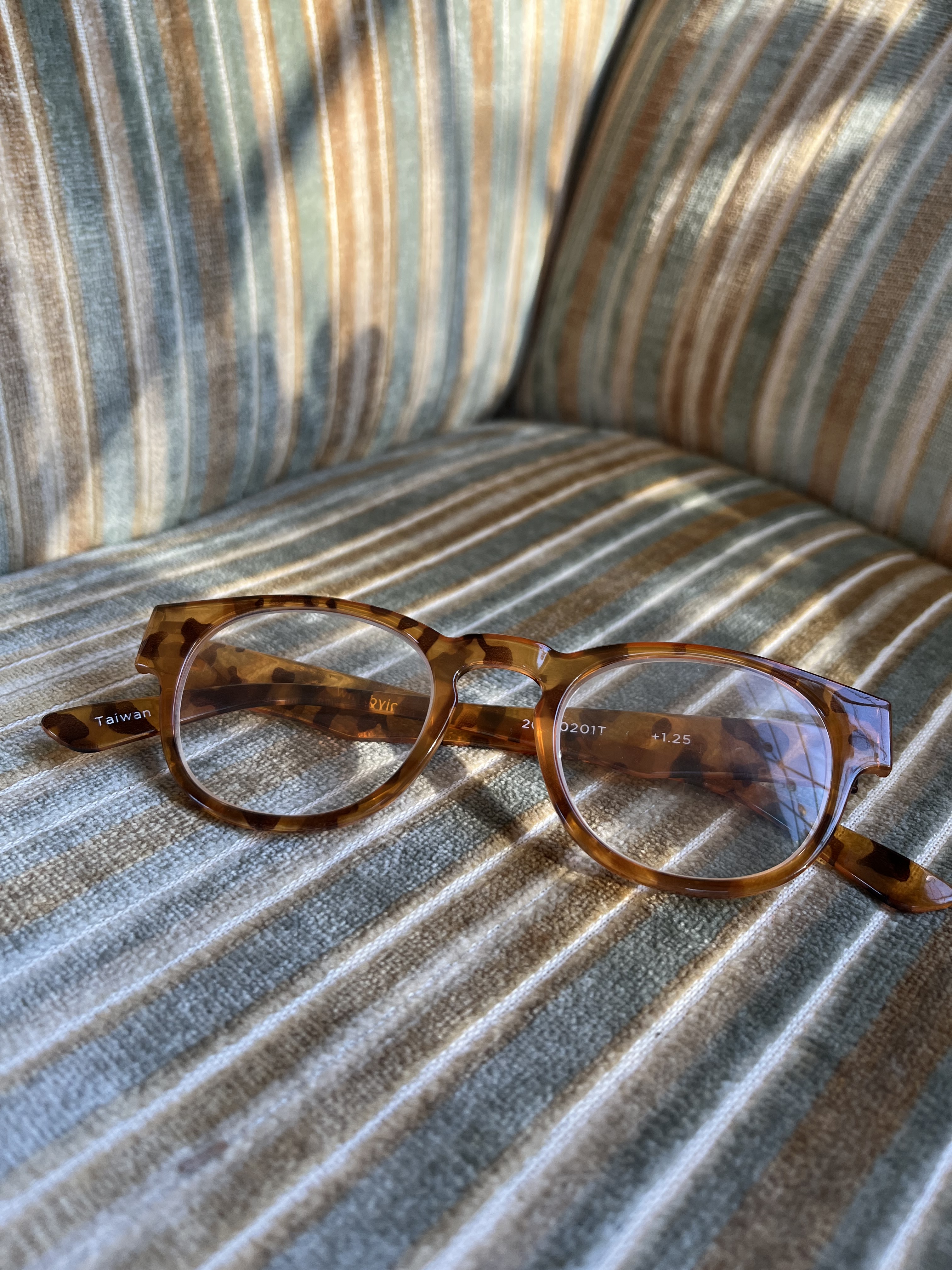
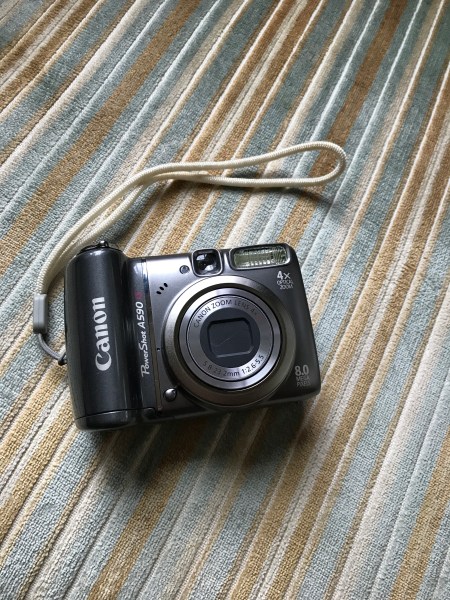
My reading glasses and the chair I inherited from my grandmother.
Chopped onions, mushrooms and garlic simmer in the pan with a little olive oil. I add a handful of spinach and push everything around with a wooden spoon.
“Here we are in the kitchen of the famous writer,” says my girl.
Wearing her soft white pajamas with gold snowflakes, she points a camera at me and talks in a tumble of quick words, her sweet voice trying to mimic the cadence of the reporters she hears on NPR.
“You may know her from her famous blog, but she is also writing two novels which are sure to be New York sellers.”
She walks closer and I turn, aware of my dirty apron and unwashed hair. The camera is on my face now.
“Can I ask you a few questions?”
“Sure.”
“When you’re famous, will you allow your books to be made into movies?”
“I guess.”
“I know you doubt your acting skills, but if given the chance, would you star in the movie?”
“No. I’d leave it to the professionals.”
“You could, you know.”
“Thanks, but it isn’t something I even want.”
I stare at her through the camera, my tone serious. Teachable moment.
“You do know I may never finish my book, and it may never be published. You know that, right?”
She sighs and smiles.
“You will mom, and you are already famous,” she says. “Because you’re awesome.”
She turns the camera on herself.
“Well, there you have it, folks. A short interview with the famous writer as she cooks dinner. Tune in tomorrow when we interview a leprechaun about the true secrets of the rainbow.”
She walks into the next room and I hear her playing the video back to herself. I wonder what she is thinking as she watches it.
Does she see the bags under my eyes or the way I cringed when she called me “famous writer”?
Does she know how much I fear I’ll never finish writing anything?
Can she possibly understand the enormous feelings her little interview exploded inside me as I cooked a frittata on a Monday night?
Thank goodness the answer is no. She is 10 years old, all she knows is she loves her mother and she believes I can do anything. I’m still a hero to her, someone to look up to, someone to admire.
Like all aspects of motherhood, it’s crushing, suffocating, messy, confusing and fucking wonderful all at once.
I don’t want to let her down.
I’ve always told her she could do whatever she wants in life.
“You are only limited by your own fears.”
I worry I will fail, and she will watch it, and all her hopes and dreams will crash along with mine. She won’t believe me anymore and I will have broken her.
I worry she will watch the video years down the road, when I am gone, sad her mother never finished those books she always talked about.
She is watching me.
She sees me trying, hears me reading sentences out loud to myself, watches me rush to scribble something on a piece of paper, listens as I tell her something new I figured out about one of my characters and hears me cry when I think I’m alone and everything feels too big.
She is watching me.
Fear and self-doubt, like Oden’s ravens, sit on my shoulders. They mock me, tell me how foolish, stupid and boring I am. Famous writer. Blah.
Yet I keep going.
I’m crafting stories and characters and worlds. It’s hours of tedious work, reworking the same sentences over and over until they read exactly as I want them to, mixed with a tiny moment where the magic sends a shiver through my entire body and I feel life pure and whole and without edit.
I don’t know how this story ends, but she is watching me.
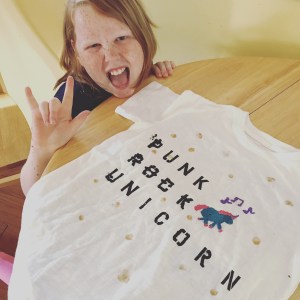
Digging through the bag of fabric paint, she knows exactly what she’s looking for. The body of the unicorn gets turquoise blue in swirling dabs, while the mane, tail and tiny hooves are carefully added with small, precise strokes of bright pink. Next, the horn and three music notes are added in dark purple.
Smiling, she dips a slim brush into a glob of sparkly gold and begins adding dots around the large black lettering of her band name, “Punk Rock Unicorn.”
“This looks so good,” she says.
She doesn’t ask what I think.
She doesn’t worry if her bandmates will like it.
She loves it.
“Can you paint my nails?” she asks. “Some blue and some pink. Oh, and with gold tips!”
I say yes, but I struggle to make it happen. The main color doesn’t reach the edge of every nail, and the gold tips are uneven.
“Sorry,” I say.
“They are perfect,” she says while wiggling her fingers in front of her face. “Thank you!”
It’s time to leave for her band’s show, the culmination of a week of Girls Rock Camp. She is wearing her favorite leggings, a faded swirling galaxy of pink and purple with visible holes in the knees. Her hair isn’t brushed and it’s matted in the back where she slept on it wet.
“Are you sure you don’t want to wear a sparkly skirt and brush your hair? Maybe add some color?”
“I look fine mom,” she says. “I’m comfortable.”
I want to fight her.
I want her to care more about how she looks.
I want her to look more put together.
But there she is, my Punk Rock Unicorn, smiling at me without any hesitation at all, while I changed my outfit several times and still wasn’t happy with my own reflection in the mirror.
This is all I’ve ever wanted for my girl, to be unapologetically herself, to not shrink for anyone, and to rock everything she does without fear or doubt.
Her confident smile is the most beautiful thing I’ve ever seen.
At the show, I watch her and all the girls playing instruments and singing with a reckless joy I don’t know I’ve ever felt in my life.
They are brave, free and strong.
They are working together, not in competition, lifting and rising as one.
I’m so happy for them…until I’m not.
Something inside starts churning up, this voice of perfectionism and criticism.
Why is my girl singing so quietly? She isn’t smiling and doesn’t look as confident as some of the others. Why did she act shy when she was given a compliment? I’m sure it’s my fault, something I’m doing wrong. I’m ruining this perfect girl.
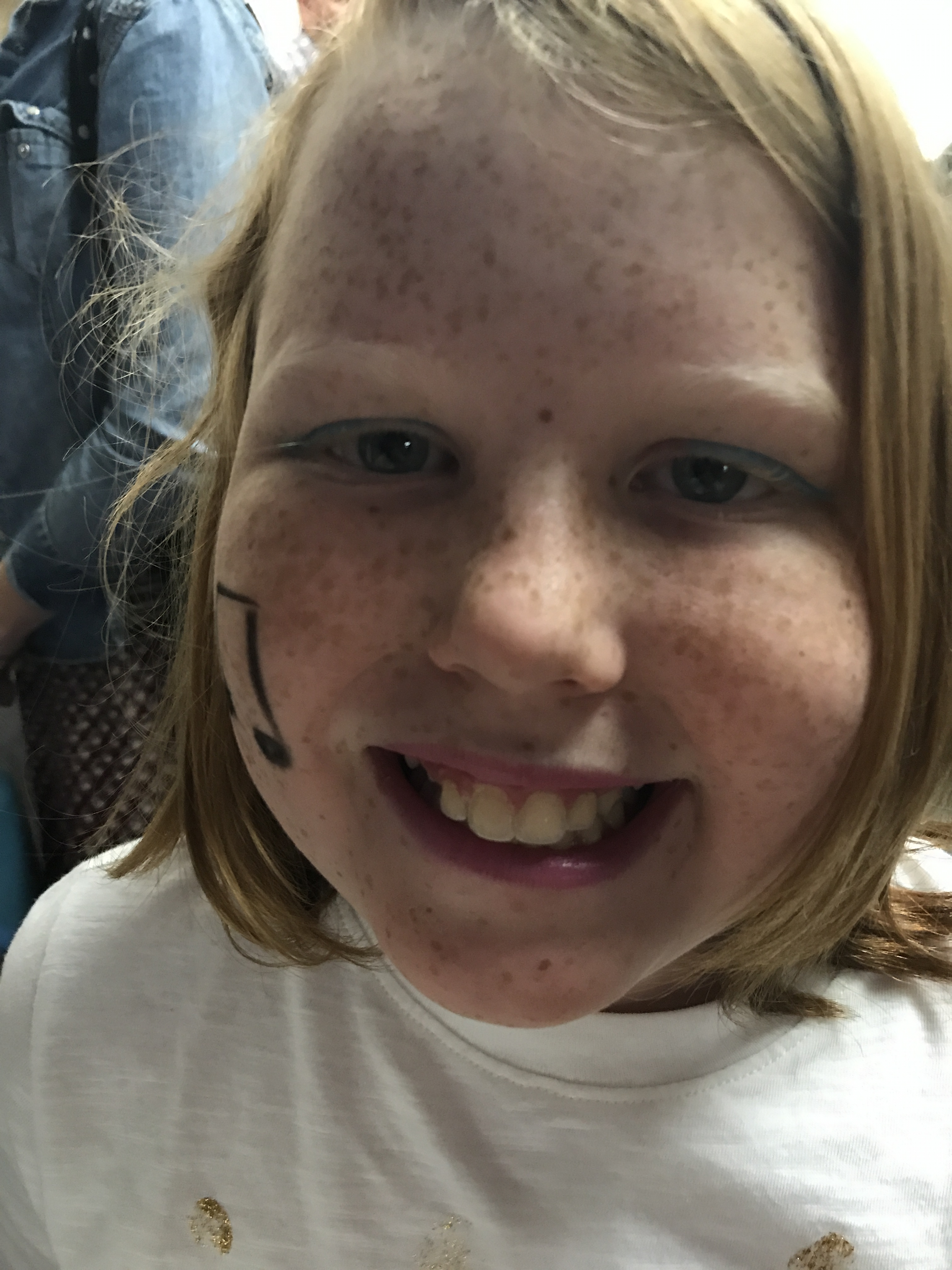
After the show, she runs to me and hugs me hard. She has bright blue eye makeup and sparkly lip gloss her coach put on her backstage. Her arms feel strong and solid.
“Did you have fun?” I ask her.
“Yes!” she says.
“How come you looked so shy up there? Why weren’t you smiling more?”
The words come tumbling out before I can stop them. I recognize this voice, the very same one sabotaging my writing and stopping me from doing anything I might fail it.
Shit.
I don’t want it to be her voice.
I search her face, looking for any trace of damage my words may have caused.
“What do you mean?” she says.
Her face is as radiant as ever.
“I’m very proud of you,” I say. “You really rocked it up there! It looked so fun. I bet you are proud.”
“Thanks,” she says. “I am!”
She melts into me, the warmth of her body like a blanket soothing my critical voices and giving me another chance.
Always another chance.
I remember her plan to have her bandmates and coaches sign her shirt.
“People are starting to leave,” I say. “Did you still want to get signatures?”
“Yes,” she says and runs off to borrow a pen.
I watch her go and make it happen for herself.
Her confidence isn’t loud or boastful, but calm and careful.
She gently taps friends and coaches, asking them to sign her shirt, standing still as they do.
I see many are holding the tiny pink unicorn erasers she spent an hour digging out of the bins in her room, the ones she so thoughtfully brought for them all.
My heart nearly bursts.
This girl is everything.
After the show, we head to dinner and she gives the waitress one of the teeny unicorn erasers, a light pink one with a purple mane and tail.
“Did you see her smile?” she says. “I think she liked it.”
“Yes,” I say. “You make everyone smile, just by being you.”
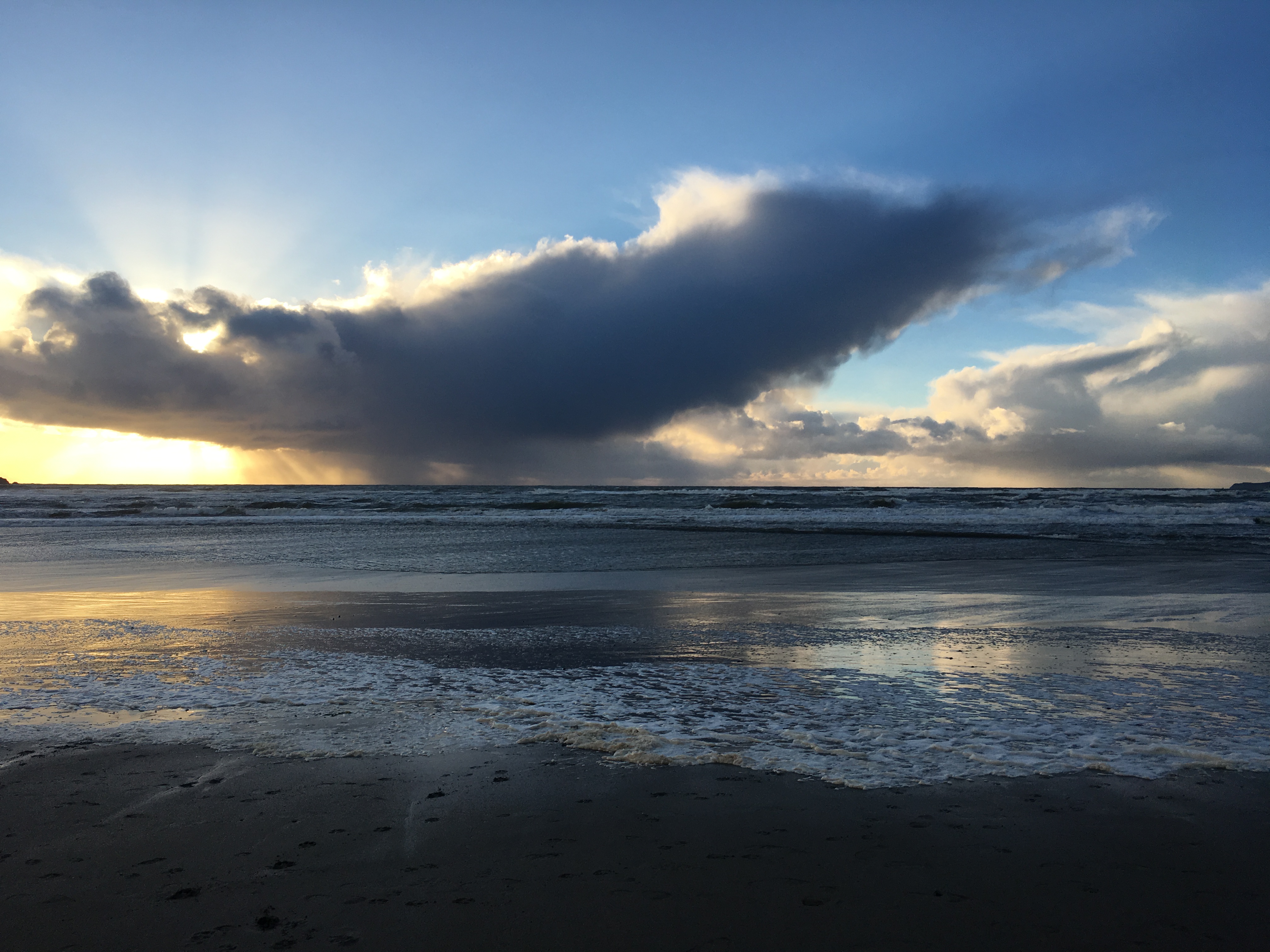
She sits with her back against me, both of us watching the sea in silence. Our breath and hearts remembering the synchronization, falling into pace again.
The black rocks bob up and down in the murky grey waves, like seals playing, like we just were; hand in hand darting from the cold foam, testing our footing on crumbling rocks and watching the sand create light circles around our feet as we step together.
The deep, grey clouds mute the color of everything, making even the stark whitecaps of the waves seem wiped away of color.
I put my hand on top of hers, and breathe in the scent of salt caught in the gilded strands.
She’s talking about life, her philosophical nature equally captivated by the waves as my own; motivations, dreams, memories, fears and ambitions.
Our voices match in pace, harmonized.
The clouds gradually shift, the wind gently pushing away the platinum grey, allowing tiny patches of bright blue to appear. With the blue comes white, brown, green and gold. It’s as if nothing is truly a color without the sun’s rays to warm it to life.
Shapes appear far out in the sea, hidden before in the dreariness of grey; black triangular rocks topped with white splashes, golden strips of land carved smooth like rising waves, royal green hills and shiny black birds suspended like kites on a string.
Our tummies growl and I know the moment must end, but I stretch it, savoring the vast warmth as if I may never feel it again.
My baby will be 10 this summer and, as cliché as it is, all those moms who stopped me in Target when my kids were little are right, it does go by so fast.
Chubby pink babies with soft folds you must lift to wash are suddenly explaining why they feel empathy for the mean girl at school with shocking insight and depth.
I feel confused; like I’m Alice shaking my head as the Mad Hatter explains the nature of time, only I’m watching my little baby perform mock episodes of both “Elmo’s World” and “Dance Moms” and wondering where her wit and timing comes from.
She has a feisty resistance to people who don’t listen to her and a sweet devotion to those who do. I see so much of myself in her, but also recognize a strength and determination which is entirely hers alone.
I trace the freckles on her arms as we talk a few more minutes. The sound of the waves, crashing and retracting, the soundtrack to our love.
I know she can’t understand the intensity of my emotions, my devotion. She doesn’t understand why I get irate so quickly when she whines; undone thinking she will have the same negative soundtrack locked in a loop inside her head. I want to shake the pain away from her, make her see only light, only good.
I vow again, silently, like every mother does, to try and be more patient and to do my best to build her up so she can handle the weight of everything to come.
I whisper I love you into her head, and it doesn’t feel like enough. Adore, admire, cherish, treasure; each word like a piece of the puzzle. She can’t know the weight of it, I decide.
She eases off my lap, so I can cook us grilled cheese sandwiches and tomato soup. She begins to sing and my heart is as full as the moon, pulling the waves back and forth, pulling us closer together again.
Almost four years ago, I began this blog to address the feelings of being drowned out and erased by motherhood. It was purely a selfish stab in the darkness.
Hello? Hello? Anybody out there?
Depression’s seed had already sprouted inside, but it would take a year or so before I began to recognize it. By then, the twisting thorny pain had wound itself through every cell, infecting all functions and clouding my vision with inky black lies.
Devouring. Suffocating. Obliterating.
I could not see.
I could not breathe.
I could not move.
This blog became the home for the words I didn’t dare say out loud, my refuge in the darkness. I could type silently the pain and anger I wished would go away, release some of the pressure, and reach my quiet hand up for someone to see.
Some of you read the words and nodded in solidarity, my sisters and brothers of shadow.
Some of you read the words and tossed me tendrils of hope, which I desperately clung to with both hands.
With every word typed and every tear cried, I’ve been ripping and untangling the dense thicket of torment and suffering I’d surrendered to.
Now, with only a few coils still attached, I’m feeling exposed and naked.
Stripped down.
Bare.
I’m free, but lost.
Seen, but scared.
I have no idea what to do next.
Depression became my identity, filling the emptiness up with dark and giving me plenty of lies to ponder and pain to feel. It became my voice; it spoke through me, providing a plethora of excuses to hide behind and inside.
Hello darkness, my old friend/I’ve come to talk with you again
I want to shed the deceitful sense of purpose depression gave me and embrace something new. I long to find the true voice inside me, the one buried by all the layers of bullshit I’ve let define me for so long.
I feel wobbly in this new space and unsure how to proceed.
So, I come here again, to this space of words and ideas. I come with eyes wide open, my heart engaged and my mind clear.
Do you see me? Will you accept this version? Will I?
Our country is so filled with division, misinformation and lies right now. We have joined the rest of the world, in a global sense of unease and unrest. There are so many things happening, so fast, it would be easier to retreat back into my self-pitying hole of depression and hunker down.
But this is the time for action.
The time to declare a new purpose and to find a new voice.
I circle the same three blocks, looking for a parking spot my minivan can fit into, feeling a sense of apprehension and anticipation. I pass the stark white walls of the 1800s fort-turned-museum and the ornate catholic church with its tiny monk statues.
These buildings are markers and judges, watching as I cry, sometimes before, and always after. I find their presence either comforting and protective, or mocking and dangerous. I’m the sinner or the saint. The settler or the native.
I’ve been making this weekly trek for several years. It has become a sort of personal pilgrimage, one I either appreciate or resent, depending on where I am in my cycle of emotions.
Up and down.
Round and round.
The fucking never-ending ferris wheel of my feelings.
Some days, walking up the steep steps of the Victorian house feel impossible, my broken heart not able to pump enough energy into my body. Other times, like this week, I fly up the stairs eager for my time with my very own listener.
“I’m not in chaos.”
I proclaim it to my therapist boldly, as I take my seat on the couch and face him. He smiles back at me in the quiet, thoughtful way he always does.
I try and expand on my declaration, but as I do, I feel the truth of the words slipping away from me.
No, I don’t want to run away from my family or hurt myself anymore. I don’t spend hours curled up crying until my stomach burns like acid. I am not drinking myself to sleep every night.
In those ways, I am not in chaos.
Yet, I see the patterns in my life I still can’t break. I feel the familiar panic, simmering under my skin, ready to first whisper, and then scream, the lies which tear me down. It’s a demon, and it will devour me if I don’t keep fighting.
I fear I’m only at the top of the ferris wheel again and I’ll come crashing back down any second. I want off. I don’t want to do this anymore. I’m so tired.
The walk back to the van is silent, as it always is. I hold my keys in my hand, the longest key sticking out between my index and middle finger, prepared to defend myself.
I didn’t cry on the couch tonight. I held it in, standing fast to my assertion I’m not in chaos, even as the doubts swirled inside. I faked feeling good.
I climb into the empty van and lock the door behind me. I sit until the interior lights turn off and I’m alone in the dark. The paper bird, Leonard, in his soft blue paper cage, hangs from the rearview mirror watching me.
I reach into the little compartment below the radio, past the mints, the earbuds and two kazoos, to the seashell and the dried leaf I know are there. I don’t take them out, I just feel them. I let my finger trace over them both, gently, as I release all I’ve held in, even from my paid listener.
I’m not in chaos.
I start home, the monks winking at me tonight and the white walls looking small and easily penetrable.
I walk into my dark house full of my sleeping family. There is a line of plastic geckos on the living room table, a stack of books, an opened bottle of glue, colored pencils and the “love drawing” my daughter did earlier in the week.
I sit on the couch and stare at the drawing, thinking of our conversation before I left.
“Do you want to move into the Love Apartments?” she asked.
“Sure,” I said.
“What floor?”
“You pick.”
“We don’t have an elevator, so you might want a lower one, that’s a lot of stairs to walk up. But not the first floor, because the views are better higher up and you’ll want a good view when you write.”
“Whatever you think.”
“You have to decide mom, and I’d act quick. There gonna sell fast.”
I barley glance at her.
“3rd floor.”
“OK.”
I can’t remember hugging her goodbye or saying I love you.
There’s a second picture on the table, a new interior view of the apartments. She must have created this while I was gone, using the big table because of the size of the paper.
I see “sold” and “BKW” on my new 3rd floor apartment.
I smile and picture myself sitting in a big comfy chair, licking an ice cream from the shop next door and looking out the window at the perfect view for writing. A grocery store, the “Bank of a Heart” and music lessons all within walking distance.
No tall white walls.
No judgmental monks.
No plunging ferris wheels.
I kiss my sleeping children gently, slip into my pajamas and cuddle up next to my husband.
“You OK?” he asks and sleepily puts his arm over me.
There is a pile of cut yarn outside my bedroom door, and five stuffed animals hang from the bannister having “flying lessons.” Every box from Christmas I put in the garage to break down, is back in the house in various stages of transformation, surrounded by tape, scissors and markers.
The dining room table is home to a puzzle on week three of progress, and a half-completed robot model. Stacks of books fill every flattish surface, teeny-tiny scraps of paper are cut up and have been thrown confetti-style down the halls, and two tiny plants appear to be in the process of being repotted by someone in the bathroom sink.
The state of my house is not good, folks. It is a cluttered mess of intentions and creation. We are a family who likes to do things, make things, get lost in the “thing,” and what we seem to hate the most is admitting the thing is over.
If the puzzle is put away, it means we didn’t finish it.
If the books are on a shelf, they may not get read.
If we clean up the boxes, the fort will never be completed.
We are a family of potential.
I have been fighting this for a long time.
I would walk around the house picking up all the messes, bitching as I do, and feeling the overwhelming sense of futility as I turn around to see several new “projects” erupting behind me.
It was driving me crazy. Ask my kids. I had become the Cleaning Dictator often yelling “take this shit to your room” and “what the hell is this mess?” and “are you kidding me?”
I’d march around in full martyr-mode, always feeling a sense of being overwhelmed or buried by ALL THE STUFF. I’d throw projects away because I’d get tired of seeing them or throw everything into a closet and slam the door to have ONE EMPTY SPACE.
Part of this battle was because my insides were in turmoil and I needed my space to not be. I needed everything organized, because I couldn’t categorize all the messy, dirty feelings which weighed me down and made it impossible for me to move.
Another part was embarrassment, of imaging what people would think if they stumbled into our “in progress” home on a day I didn’t frantically shove things into closets or drawers. They might think I am lazy or I don’t give a shit about my family.
I was losing my mind over it.
I was on the verge of completely squashing my kid’s creativity, because I could not contain it.
I could not stand it.
Then I started writing again.
My writing is a mess; the characters are unformed, stumbling along trying to become real and struggling with the half-story I’ve placed them in. I’m having to slowly uncover the pieces and letting it be a jumble for now, while I figure out how it all fits together.
It almost stopped me completely.
Twice.
I’m still writing.
I’m accepting this mess is part of the creative process, and I’m trying to explore it with patience and curiosity. It’s hard to ignore the unease it brings, but it is necessary. I am not going to just sit down and write a novel. It is a chaotic, disorganized and jumbled process which requires both ignoring my fears and embracing them.
It’s fucking hard guys.
But doing this, being in the trenches, has made me look at the mess of my house, and even my kids, in a different way.
I’ve always been supportive of open play and creativity, actively fighting to provide them the space and time for it; we drive 25 minutes so they can attend a Waldorf school which is in line with these ideals. But at the same time, I’ve been a nagging bitch about the messes which come along with it.
Contradictions are apparently my thing.
There is a big part of me which would love my house to look like Restoration Hardware; seriously, everything in that store is gleaming and beautiful and fucking rad.
But it never will.
People don’t live there.
Duh, right?
I can’t remove the mess, because WE are the mess. I’d be replacing all the little stories they create with their stuffed animals, all the pictures they draw, all the badges and houses and forts…for some idealistic version of a home I’d probably hate.
I want my kids being loud and crazy and wild.
I want them making shit out of everything.
I want my kids to know their ideas are worth exploring fully.
The dishes and laundry are done. There isn’t anything rotting or smelling bad in the house. It is just projects, crafts and imagination exploding out in all directions.
It is the chaos of a creative life.
There is an important lesson for us all to learn about finishing things, cleaning up after ourselves and respecting the space of others. I’m not throwing up my hands in defeat. There is plenty of work to do still, and I’m sure we can get there.
For now, though, I want to stop yelling and allow more space and time for the messy creativity to happen. I want to stop struggling so hard against it, and learn to give things the time they need.
Maybe I can even learn to love the mess as much as I love the kids who create it.
Probably not.
But I can stop how I react and realize how temporary this all is.
So, bring on the Styrofoam sinks:The random piles of coins:Whatever this is:Bring it on.
He is bouncing in the back seat as we pull into a dirt driveway. The neighborhood is filled with ranch-style homes and there are horses in every field. He holds my hand tightly as we ring the doorbell, his sister on my hip.
My 4-H leader from when I was a child greets us and hugs me to her. It has been over 20 years since we’ve seen each other and she marvels at how grown-up I am. I introduce her to my children. My boy is 4-years-old and is wearing his favorite long-sleeve t-shirt with a kitty and a heart on it. His sister is 2 and she won’t let me put her down.
This woman I knew so well as a child feels like a stranger. She shows me pictures of her children and grandchildren. I only have vague memories of my time shared with this family and I feel suddenly old and slightly nostalgic.
We follow her through the kitchen and down three stairs to a dimly lit room. All along the back wall are cages, stacked five high, filled with guinea pigs. We can hear some moving around and several wheek a greeting to us. My boy is wide-eyed and bouncing again.
She tells us one of her guinea pigs was flown to Los Angeles to be used by the animators who made “G-Force.” This was the first movie my son saw on the big screen and he looks at me almost in tears from excitement. She takes out two little guinea pigs for him to choose from.
He only takes a moment. He points at the smallest one. She is the Teddy variety, a wiry haired breed known for resembling the stuffed animal they are named after. She is black, white and brown.
He names her Guinea The Pig.
This was seven years ago and she was my Valentine’s Day gift to him.
Since then, she has been featured in hundreds of his drawings, clay figures, short stories and even a few comic strip panels. He has created costumes for her, she has a stocking at Christmas and there isn’t a day he doesn’t pet her or watch her eat.
When I walk down the stairs every morning she greets me with her familiar wheeking sound, calling for veggies from the fridge and a little petting.
Her sound is as familiar to me as the hum of the refrigerator and I didn’t notice its absence until I saw the look on my boy’s face.
“Guinea is dead,” he says.
As he says the words, the reality hits him and he begins to sob.
We sit on the couch and his sister joins us and we all cry together for our sweet little piggy, our Super Guinea, our Steam Punk Unicorn Pig and my son’s favorite thing in the world.
We drive sister to school, but I let him come back home with me.
He sits down at the art table and begins drawing pictures and making pipe cleaner figures of his sweet Guinea. I can see tears come often, but he quickly brushes them away.
I want to comfort him, but something stops me. When he was little, I’d cuddle him in my arms and kiss the tears off his cheeks. He would tell me things and I’d listen.
He is 11 now and things are different. He listens to music with his door closed. He continuously turns the amp up while playing his guitar until I’m forced to tell him to turn it down. He reads books for an entire Sunday morning alone in his bed.
I don’t know what to do.
I try and busy myself around the house, but keep finding him near me.
I finally sit in my big comfy chair and he crawls in next to me.
We sit in silence for a long time and I just feel the weight of him next to me. My boy, whose feet are bigger than mine and who wears deodorant now, feels the same in my arms as always. I rub his head and he purrs into me.
I know exactly what to do.
I kiss his head and listen as he tells me how much he will miss her. We talk about other things too and the morning melts away in my chair.
We eventually make our way to the computer to look at pictures and videos of Guinea. We laugh at the video of him at 4-years-old trying to walk her on a tiny leash in the yard. We marvel at how little she and he both were.
Then he asks to see pictures of himself as a baby. We start with the painting of the nursery photos, and move through newborn hospital shots, pictures of him in my soft blue baby sling, propped up next to his baby cousin, sleeping on a blanket in front of the fireplace, starting to roll, crawling on all fours, videos of him laughing, food on his face, 1st birthday, playing in the backyard, dressing up, riding the tractor with grandma and on and on.
After an hour of pictures, I tell my boy we’ve had enough and turn off the computer.
We decide to get dressed and go eat lunch at the bookstore. On the way out the door, I point at the giant stack of books next to my chair.
“Don’t let me buy another book,” I tell him. “You don’t need one either. We are just looking.”
We end up buying magazines, because they aren’t books, and sandwiches. We find a cozy place on the patio to read, eat and drink tea.
“Mom,” my boy says.
I look up.
“Do you see that napkin over there?”
He points to a brown napkin stuck on a small rosebush. It is blowing slightly in the breeze.
“Yeah,” I say.
“I’m going to free it,” he says. “It deserves to have an adventure.”
“You should pick it up and throw it in the garbage,” I say.
“That’s no fun,” he says. “It will end up there eventually, why not let it have a little adventure?”
He stands up.
“It is recyclable anyway,” he adds.
He runs over and pulls the napkin loose from the rosebush. It flies through the parking lot and out of sight. He smiles and returns to his magazine.
 Chopped onions, mushrooms and garlic simmer in the pan with a little olive oil. I add a handful of spinach and push everything around with a wooden spoon.

 She sits with her back against me, both of us watching the sea in silence. Our breath and hearts remembering the synchronization, falling into pace again.

 I sit on the couch and stare at the drawing, thinking of our conversation before I left.
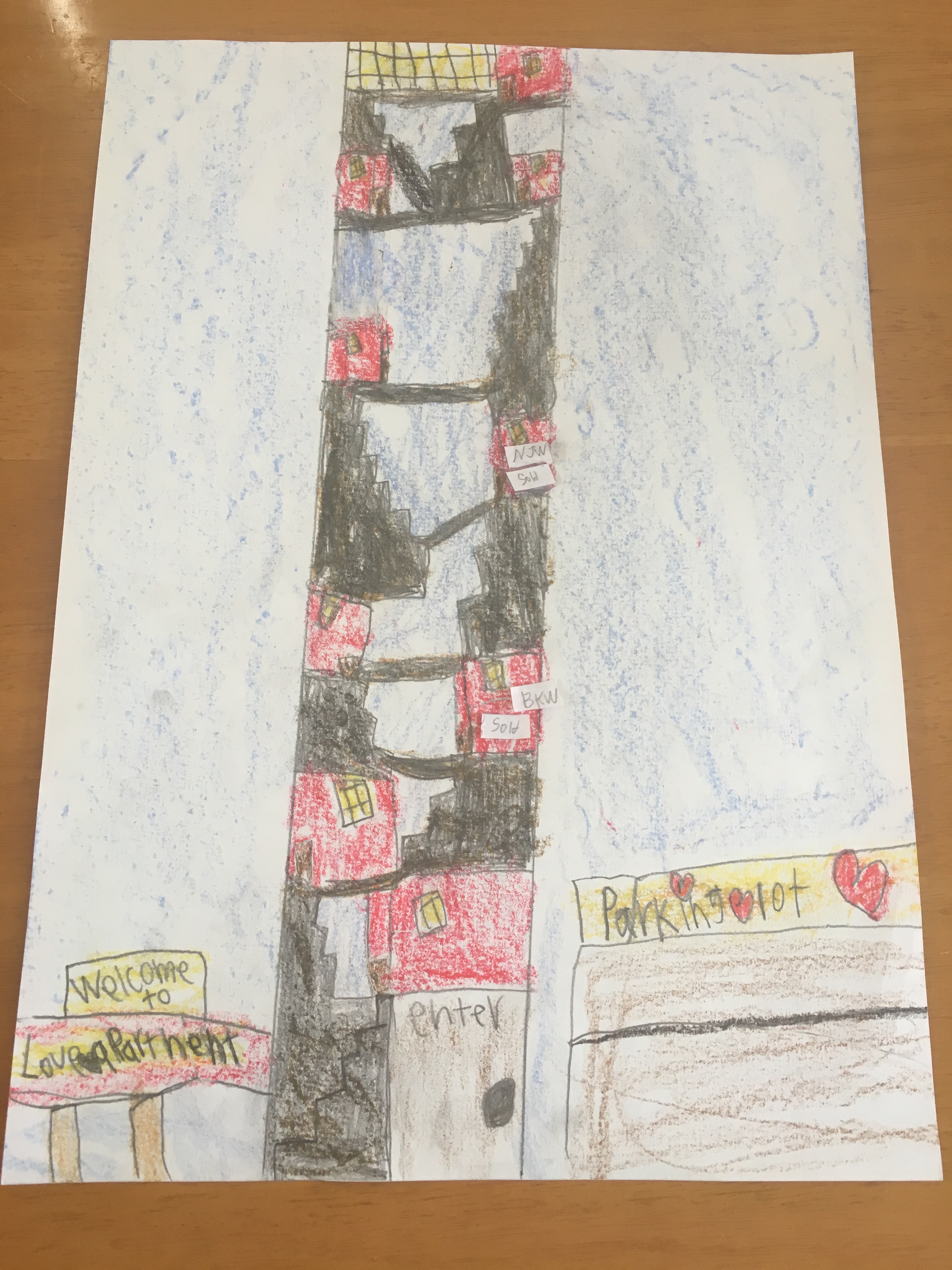 I see “sold” and “BKW” on my new 3rd floor apartment.
 The random piles of coins:
 Whatever this is:
 Bring it on.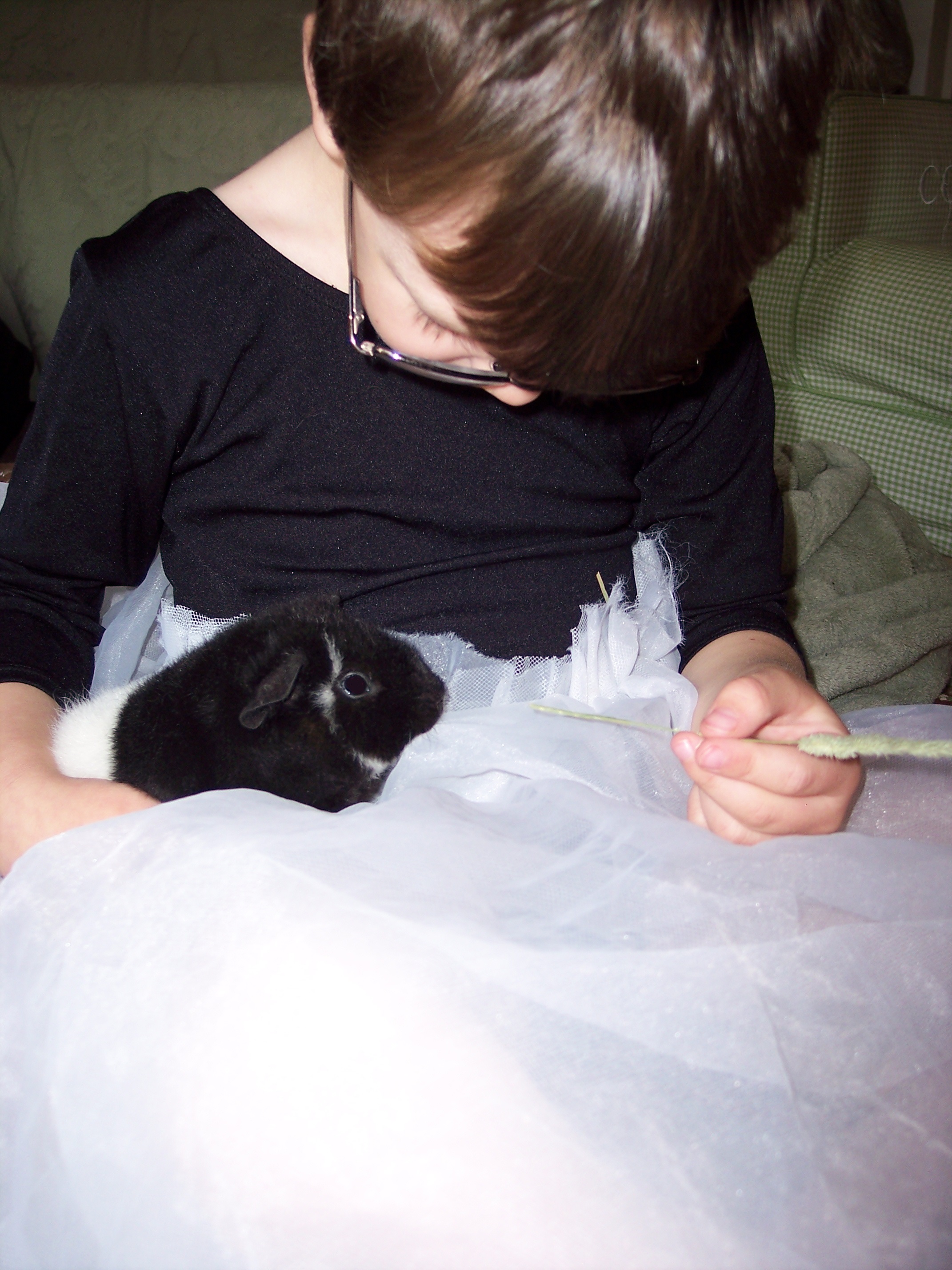

 Bridgette Tales