you get stoned say you’re proud say you’re sorry say I’m beautiful
I believe you motherhood cuts deep your scars shine
like mine
My Daughter
you’ve inherited broken glass jagged-edged shattered dreams that are not yours
I tried smoothing them with cold ocean waves deep muddy lake dives but they still cut
you don’t believe me because fresh wounds sting lines etched into softness but I see you
I’m proud of you I’m sorry you are beautiful
Mother’s Day isn’t an easy day for many, but I hope today you find solace in knowing motherhood binds us more than separates us. We all come from birth. We all are broken. We are all doing our best. May you find a piece of love to hold today and every day.
With callooh quickness sidestepping his blade I cry out “nobody outgrabe’s me”— Gimble circles me.
Eyes locked together two lost-raths in the night frabjous moon laughs— Gimble sees me.
Beamishly he stares eyes dripping tears remembering our love gyre kisses lost— Gimble flees me.
Trailing behind him whiffling white fluff swirls softly around my tulgey toes— Gimble forsakes me.
Again. Coward.
Note: This poem uses neologisms found in Lewis Carroll’s famous Jabberwocky poem and was started as an assignment for a poetry class I took from M. Todd Gallowglas last weekend. It’s got a bit of a different tone than I usually write and I’d love to know what you think. Thank you!
what if the calling crows think you are a makeshift scarecrow built for chasing them away from their dreams? will they peck at you with sharp beaks so far from my grasp? will I be able to run fast enough to save you? the shifting rice tells me to take a deep breath. this isn’t a cornfield and the cranes won’t hurt you. but grey skies mean trouble so run to me anyway my boy. mother needs you in her arms.
Shoebox Poetry: This is the fourth poem in my series based on an old box of photos I inherited when my grandmother died in 2004. The back of this photo reads “Gary in rice field Nov ’53.” It’s a photo of my dad, but it made me think of my own boy. He turned 18 in December and is finishing high school in a few months. This poem poured out instantly along with some tears. I guess I have some feelings.
Here are the other poems in the series if you missed them:
You carve our names “E+K” into the ancient oak behind your daddy’s church in hopes I’ll see, but I’ve grown tired of playing your endless
games. My drawers overflow with your teeny-tiny top-secret messages penned on newspaper scraps— “I miss you,” “meet me behind the old Bulto Market,”
and “kiss me, dearest Kate, I’m dying for you.” Just words. I need more than blue-eyed winks and brief hidden embraces. My love needs
sunshine—warm, bright, radiating fire so vibrant it can’t be stoppered or hidden. Explosive volcano love, running thick down our bodies. Popcorn love, loud hot
buttery passion devoured with both hands. Instead, you give me your blurry photograph standing at 301 Caroline Street, our secret kissing place. You write in
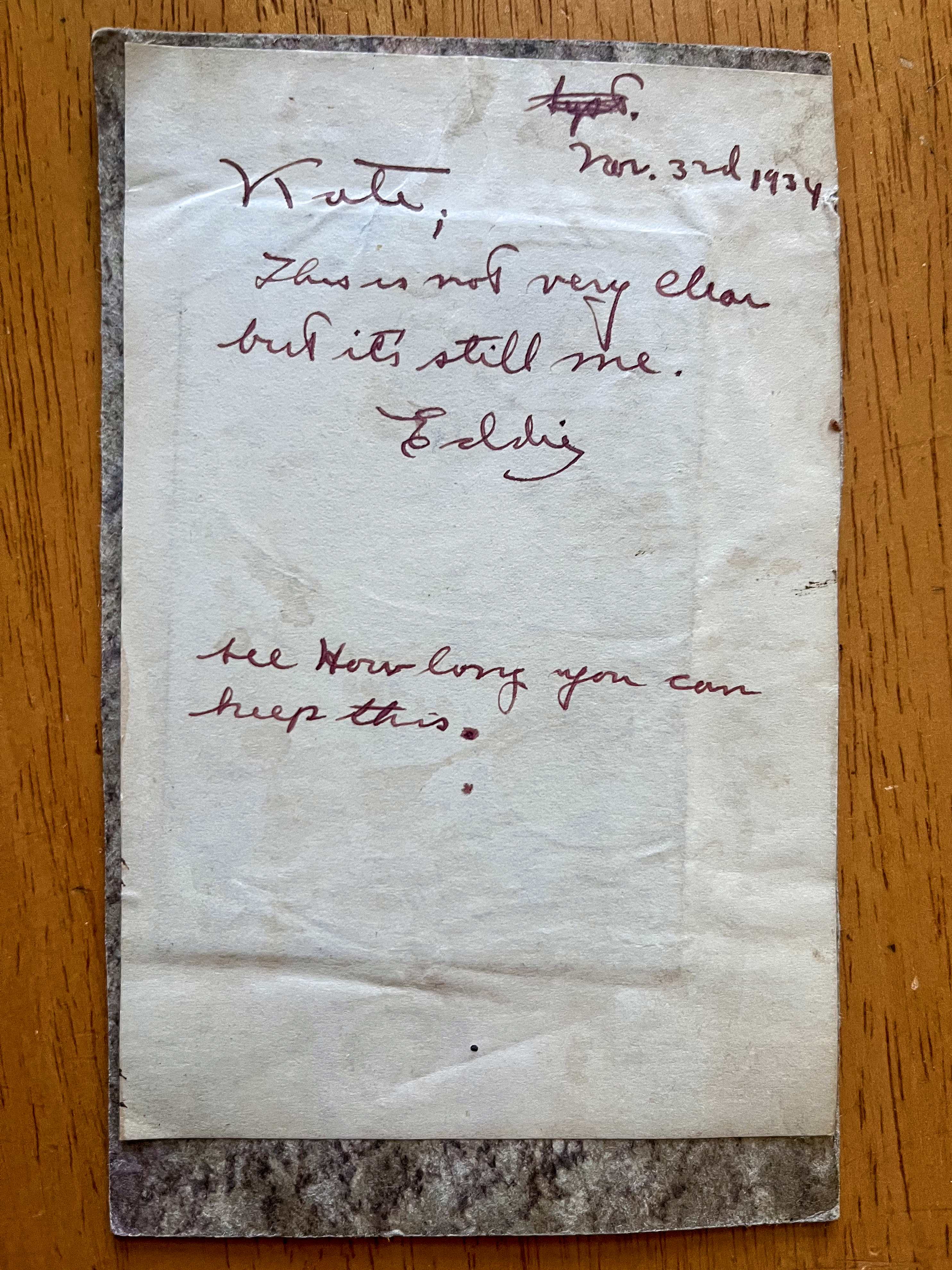
sweeping curvy letters “this is not very clear, but it’s still me. Eddie.” Blurry love is what you offered, thinking I’d accept, but I deserve
someone who wants our love to be broadcasted, shouted, screamed into the streets. Bullhorn loud love. Free to be me love. So, I chased you
onto the old bridge, calling out through hot tears, “choose all of me or none of me.” The bright moonlight stretched my dark shadow so
it covered you entirely as you walked away without looking back. My young love never wavered, but yours wasn’t brave enough to fight. It’s funny
now, finding your thoughtless dare scrawled in ink, “see how long you can keep this.” I kept it forever, blurry Eddie. Not for you, though
for me.
I stayed in focus.
Shoebox Poetry: This is the second poem in my series based on an old box of photos I inherited when my grandmother died in 2004. I don’t have any idea who Eddie was, but I wanted to rewrite a possible old love story as a moment of empowerment for my grandmother. She was a fierce woman and I like to think she kept this photograph as a reminder of her strength. If someone out there happens to know Eddie, sorry. This is pure fiction and I’m sure he is/was a lovely man.
pictures on sundays wearing pure white pearls, flowers, smiles
but not before
we wash in the family tub first dad and then my ten brothers then mother then me cold dirt shame s i n it absorbs deep into my soft skin my thick blood my frail bones leaving me scabbed broken apart dirtier than before but mother covers it all with white
smile, she says but I’m thinking of willow trees carving my name with a sharp knife pomegranate juice running down my chin screaming at the stars
straighten up, she says but I’m thinking of foggy forests walking barefoot through mossy earth honey dripping from my fingertips bathing in the moonlight
be sweet, she says but I’m thinking of roaring waves sunlight on freckled shoulders seaweed stuck between toes salt water taffy kisses
be quiet, she says but I’m thinking of throwing things messy hair and dirty fingernails cadmium yellow, ultramarine blue painting my own life
but not before
pictures on sundays wearing pure white pearls, flowers, smiles
Shoebox Poetry: Last week I rediscovered an old box of photos I inherited when my grandmother died in 2004. This poem is the first in a series of poems using those images as inspiration. Today’s photo is of my grandmother as a young woman. There is no date, but the sweeping handwriting on the back says “Kate, Gill St.” And yes, she told me her entire family bathed in the same water every Sunday before church. Can you even imagine?
my body does not understand reacting with sharp vibrant stabs singing fight or flight ballads —do or die chorus numbers where kids say teary goodbyes under too-far-away stars under wet weeping willow trees under rich dark black soil under sadness turned into madness —my wounded heart finally stops
no, I tell the flowers that’s not the real story not yet anyway, not now —curving pink petals nod agreement where hummingbirds take small sips under muted late February sun under thick cotton candy clouds under pale white peach blossoms under folded tissue paper cranes —my healing heart grows stronger
There once was an orphan who traveled alone at sunrise through a vast forest. As the pink sky touched the cold ground the wind woke. It swirled and roared. It raged and tugged. The orphan was startled but didn’t stop.
She double-knotted the yellow ribbon in her hair, tucked her silver locket beneath her old cloak, and walked and walked. The world around her was alive with sounds, but she heard none, for she was lost in the depths of her enormous grief.
It came to pass she found herself at the bottom of a steep hill facing a rather large tortoise. The two looked at each other for a long time without speaking. It was the tortoise who finally sliced through the silence with his rough, slow voice.
“I’m dying. There’s no other way to say it.”
The orphan didn’t know how to respond and so she said nothing. The wind blew bits of stones and leaves down the sloping hill, some of them landing on the tortoise’s large, round shell. The orphan picked them off one by one.
“I’d like to die at the top of this hill and not the bottom, for it’s better to go up than to go down. Don’t you think?”
The tortoise spoke with certainty, but the orphan had never thought of this before. After giving it several minutes of consideration, she nodded her agreement and spoke.
“I will help you.”
With this, she and the tortoise started up the side of the rocky hill. The going was very slow as the tortoise was old and the wind blew strongly. Each step required a considerable amount of effort. The girl tried everything to move the tortoise faster—lifting, pushing and pulling. But the tortoise was too large and she was too small.
“I don’t know what to do.”
She sounded defeated, but the tortoise blinked at her with watery eyes and said nothing. He had faith in her and so she had to keep trying.
Hours passed with very little progress and although the orphan tried as hard as she could to remain positive, she soon became gloomy and frustrated.
“Wind, do you hear me? I need your help.”
The wind isn’t used to people speaking directly to it, so it decided to answer.
“What do you expect me to do?”
It didn’t take the orphan long to come up with an idea, for she was a clever child with an earnest heart.
“If you could blow in the other direction, it would help me in pushing the tortoise up the hill.”
It wouldn’t be hard for the wind to change direction, but it was stubborn and didn’t like being told what to do.
“What will you give me in return?”
The orphan looked at the tortoise and at herself. She had very little to offer, but not nothing.
“I will give you my yellow hair ribbon if you help us.”
The wind had been tugging at the ribbon for most of the morning and it did indeed want it. The color matched the sun and the wind thought it would look lovely soaring in the clouds.
“Very well. If you give me the ribbon, I will help you.”
The orphan felt sad, for her father gave her the ribbon, but it was the only way to help the tortoise. She untied the double knot and the wind ripped the ribbon from her hand in an instant. She watched it fly through the air and then felt the breeze change, so it pushed at her back.
“Thank you, wind! Now we will reach the top in no time.”
Indeed, the orphan and the tortoise made great progress up the hill, but as the sun reached the center of the sky they came upon a rushing river too wide to step across and too fast to walk through. The water splashed at her bare feet and she again felt gloomy and frustrated.
“I don’t know what to do.”
It seemed an impossible thing to cross such a river, but the tortoise blinked at her with watery eyes and said nothing. He had faith in her and so she had to keep trying.
“River, do you hear me? I need your help.”
The river was used to people crying tears at its banks or throwing in wishing stones but rarely did someone address it directly. It was impressed by the orphan and decided to answer.
“What do you expect me to do?”
It didn’t take the orphan long to come up with an idea, for she was a clever child with an earnest heart.
“We need to cross your waters but you are too fast. Is there a way you could slow down to let us pass?”
The river could slow, but it rarely did so. It was proud of how strong and fast it flowed.
“What will you give me in return?”
Again, the orphan looked at the tortoise and at herself. She had very little to offer, but not nothing.
“I could give you my shiny locket to dance within your churning waters. It would look very pretty amongst the rocks and the fish.”
The orphan pulled open her cloak and the river saw the sparkling silver heart strung around her neck. It did want to feel the joy of having something so stunning in its waters.
“Very well. If you give me the locket, I will help you.”
The orphan was sad, for her mother gave her the locket and it contained a tiny picture of the two of them, but it was the only way to help the tortoise. She gave the smooth silver a kiss and threw it into the water.
In a flash, the locket was swept away by the fast current. The water laughed with glee and then started to slow. Soon it was a narrow brook, bubbling over a sea of colorful stones. Although their feet got a bit wet, they were able to cross and continue on their way.
“Thank you, river! Now we will reach the top in no time.”
For a while, they walked on easily with the aid of the wind, but soon it came to pass that a giant boulder made of dark grey stone landed in front of them with a booming thud. It covered the entire path and the orphan could see no way around it. She pushed and kicked at it, but it did not move and again she felt gloomy and frustrated.
“I don’t know what to do.”
She wanted to cry for the boulder was so gigantic and heavy, but the tortoise blinked at her with watery eyes and said nothing. He had faith in her and so she had to keep trying.
“Boulder, do you hear me? I need your help.”
The boulder didn’t respond, but a tiny troll hiding within its shadows did. It stepped out and scowled. It looked almost human except for its body was covered in twisting dark mushrooms and its skin was dark grey.
“What do you expect me to do?”
It didn’t take the orphan long to come up with an idea, for she was a clever child with an earnest heart.
“We need to get to the top of the hill. Could you move the boulder for us?”
The troll didn’t trust humans for they always made fun of its ugly appearance, but the child didn’t laugh or make faces. The troll scratched its belly and sat on the ground crossing its legs in front of it.
“What will you give me in return?”
Again the orphan looked at the tortoise and at herself. She had very little to offer, but not nothing.
“I could give you my cloak. It’s not fancy but it will keep you warm and will make it easier for you to pass through town without being noticed.”
The troll liked this idea very much. Moving a boulder was easy for such a reward.
“Very well. If you give me the cloak, I will help you.”
The orphan was sad, for her grandmother had made the cloak for her, but it was the only way to help the tortoise. She unclasped the wooden button holding it in place and handed it to the troll.
With great delight, it leaped to its feet and flung the cloak around its hunched shoulders. Almost invisible within the black fabric, it pressed the boulder hard with its gnarled hands until it wiggled free from the path and rolled down to the bottom of the hill.
“Thank you, troll! Now we will reach the top in no time.”
The troll ran toward town and the orphan and the tortoise continued on. As the orange sun touched the horizon, signaling day’s descent into night, the wind slept and they finally reached the very top of the hill. The tortoise settled beneath the shady branches of an old oak tree and smiled widely at the orphan.
“Thank you for helping an old tortoise to make its final journey. I will die now, but before I do I must ask for one final favor. It’s very important to me.”
The orphan looked down at her pale pink shirt and torn blue skirt. She had nothing for the tortoise and the thought made her very sad. She wanted to help but her ribbon, locket, and cloak were gone. She had nothing else to give.
“What could I give you?”
The tortoise wanted to say “you have given me so much already” but it had very little time left. Instead, it extended its neck as far as it could out of its shell and spoke its final words.
“After I have died and the moon rises high in the sky, take one of the rocks from the ground and smash my shell to pieces. Promise it will be done.”
The girl was horrified at the thought, but the tortoise blinked at her with watery eyes. He had faith in her and so she said she would do as he asked. He smiled, closed his eyes, and within moments the great big tortoise had left the world.
A full moon danced across a sky of bright blinking stars. The girl wept for the tortoise and then for herself. Not only was she an orphan, but she’d given away the last remaining pieces of her life. There was nothing left to do but fulfill her promise to the tortoise and hope for a better tomorrow.
It didn’t take her long to find a big rock, and with her eyes squeezed tight, she hit the shell as hard as she could. It made a loud cracking sound and she fell backward onto the ground.
It was several minutes before she dared to look, but she was astonished when she did. The tortoise shell lay split down the center and instead of exposing the soft body within, the shell was filled with glittering gold pieces and bright colorful gems. It was a large enough treasure to live the rest of her life in comfort and luxury.
The orphan cried happy tears for she would not have to struggle anymore.
“Thank you, tortoise. I shall never forget you.”
The girl tore a piece of fabric from her skirt and made a pouch to hold the treasure. As she walked to town, she imagined all the ways this good fortune could be shared with others. For she was indeed a clever child with an earnest heart and would live happily for the rest of her days.
Note: In my writing class this week, we read an article on the elements of a good fairy tale. It brought back many fond memories of reading to my kids before bed and their years of Waldorf schooling.
With a burst of inspiration, I wrote this fairy tale in a single afternoon. It’s very different than my typical writing style and I actually broke some of my writing rules, but it felt like the thing I needed to write—some levity during a time of struggle. I hope this story brings a smile to your face and maybe you can share it with a child in your life.
through multi-colored glass down simple carpet floors white walls turn brass tears transform into doors
shadow trees grow there lightening flowers do too whispers come for repair howling monsters to spew
creaking boards hold ache light bulbs illuminate pain rafters rattle and shake trauma flows like rain
lose yourself, my child within safe caring walls connect with inner wild listen to phoenix’s calls
for inside healing house nothing stays for long come in quiet mouse leave brave lion strong
*This poem was inspired by a comment left on my blog by Grounded African and is dedicated to everyone attempting to enter a building like this to heal and connect in therapy, especially my darling daughter. May you find your way through the dark.








 Bridgette Tales